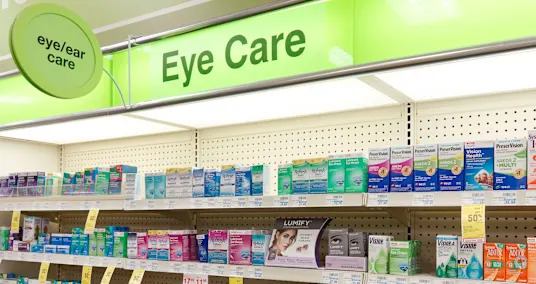
U.S. health regulators are warning Americans to check their eye drops after more than 3.1 million bottles of eyedrops sold in pharmacies nationwide were voluntarily recalled due to concerns that they may not be sterile.
All of the affected eye drops are made by K.C. Pharmaceuticals, and include the company’s “Artificial Tears,” “Advanced Relief,” “Dry Eye Relief,” and “Redness Lubricant” drops.
The recall doesn’t necessarily mean that these drops are contaminated, but that the manufacturer can’t guarantee that the products are free from infection-causing bacteria or fungi. K.C. Pharmaceuticals has voluntarily recalled some of its eye drops, but the Food and Drug Administration (FDA) is warning consumers to check their medicine cabinets and throw out any potentially hazardous products.
Which products have been recalled?
Eight different eye drop products made by K.C. Pharmaceuticals have been recalled. All are generic products, meaning they are sold under the store brand names, including Kroger, H-E-B, CVS, Rite Aid and Walgreens. The types of products that were recalled are:
Sterile Eye Drops A.C.
Advanced Relief Eye Drops
Dry Eye Relief Eye Drops
Ultra Lubricating Eye Drops
Sterile Eye Drops (original formula)
Sterile Eye Drops Redness Lubricant
Artificial Tears Sterile Lubricant Eye Drops
Sterile Eye Drops Soothing Tears
The recalled products have expiration dates ranging from April 30 to July 31, 2026. Many of them can be identified by their Universal Product Code or National Drug Code numbers. Here’s a full list of affected products.
What to do if you bought recalled eye drops
The FDA’s recall did not include instructions for consumers but, generally speaking, it’s best to throw out any affected products. You may also be able to return recalled products to where you purchased them for a refund, according to the FDA.
K.C Pharmaceuticals initially recalled its eye drops on March 31, so the products have likely been pulled from store shelves by now. But if you’re shopping for drops, it’s wise to cross-check the labels with the full product recall list, especially if you’re considering buying the store brand.
Eye drops that are not sterile can pose serious risks
The good news is that no contamination has actually been detected thus far, and no one has reported an infection resulting from using any of K.C. Pharmaceuticals’ eye drops.
K.C. Pharmaceuticals’ eye drops were recalled primarily due to a “lack of assurance of sterility,” the FDA said. That means that the company cannot guarantee that its products weren’t contaminated during production or packaging. If the products aren’t sterile, they could contain bacteria, fungi, spores or viruses that can pose serious risks.
“Whenever we talk about using eye drops for the ocular system, it’s really important that there’s no bacterial contamination because that can cause significant and sight-threatening infections,” Dr. Nicole Bajic, a Cleveland Clinic ophthalmologist, told Yahoo.
Beyond pain and irritation, these infections can cause yellow or green discharge and blurred vision. In 2023, 81 people developed rare, antibiotic-resistant infections with the bacteria Pseudomonas aeruginosa after using contaminated eye drops. Four of those people died and four had to have an eye surgically removed. Another 14 patients experienced vision loss.
Bajic noted that it can be difficult for patients to determine if their symptoms are run-of-the mill eye dryness or irritation, or if they have an infection from contaminated eye drops — or another source. But if you have worsening eye pain, vision, irritation or light sensitivity that isn’t improving with artificial tears or warm compresses, you should see a health care provider immediately, she said.
How regulators keep eye drops safe — and why recalls happen
FDA regulators require a rigorous process to ensure that products that need to be sterile are made safely. Manufacturers have to make their products in a sterile environment, go through a process of removing any potential bacteria or other microorganisms from their products, test them, keep them in a holding period to see if they grow any harmful microbes and meticulously seal them.
If at any point in this complex chain of events something goes wrong — whether the production plant finds contamination in its facility, or plastic seals are defective — then a manufacturer can’t guarantee that the product is sterile, and is obligated to recall it. If they don’t, the FDA will request or mandate that the company issue a recall.
Sterility issues are a more common problem in over-the-counter eye drops than prescription ones, but thanks to these strict regulations, it’s extremely rare for any eye products to be recalled. When they are, it’s to be taken seriously.
Tips for using eye drops safely
Eye drops can help alleviate symptoms such as dryness and irritation, but only if you use the right kind. Bajic said that her number one priority when recommending products to her patients is that they make sure they’re getting true artificial tears, rather than redness-reducing drops.
Artificial tears mimic your eye’s natural lubricants, while redness relieving products use ingredients that only have a temporary cosmetic effect. And, because they reduce redness by constricting blood flow to your eyes, these drops create a “vicious cycle” that dries your eyes out more as you use them, Bajic said.
Additionally, the number of eye drop recalls has been growing in recent years. Bajic said that “the prevailing theme seems to be that generics make up the bulk of them. Historically, I’ve told patients … that I don’t feel strongly about choosing brand names for artificial tears, but seeing the pattern that’s emerged in these recalls, I feel more confident recommending brand-name products.”
Eye Drop Safety, a consumer safety organization, advises against using products that claim to be “natural” or “homeopathic” because the FDA doesn’t regulate them like it does other artificial tears, meaning that they may not be safely produced or might contain unproven ingredients.
latest_posts
- 1
 UN chief calls on Yemen's Houthi rebels to free all UN detainees
 - 2How federal officials talk about health is shifting in troubling ways – and that change makes me worried for my autistic child
- 3Find the Excellence of Old style Expressive dance: Encountering the Effortlessness and Polish of Dance
- 4Key Business Regulations to Consider While Arranging Your Independent venture
- 5A mom's viral post is raising the question: Do kids need snacks? Dietitians have answers.


- Instructions to Augment the Presentation of Your Kona SUV
- 2025 among world's three hottest years on record, WMO says
- Factbox-China's crewed lunar programme eyes astronaut landing by 2030
- Most loved Amusement Park for Small children: Which One Do You Suggest?
- New method spots signs of Earth's primordial life in ancient rocks
- Catch the moon dancing with bright star Regulus tonight
- Flu season is ramping up, and some experts are "pretty worried"
- A Manual for Nations with Extraordinary Food
- Journey through Pages: A Survey of \Plunging into Scholarly Universes\